
Options Trading
Smart and simplified. Options trading at Wesleed helps you pursue market opportunities intelligently.
What is Options Trading?
Options trading is the act of buying and selling options. These are contracts that give the buyer the right, but not the obligation, to buy or sell an underlying asset at a set price. In the money options can be exercised within a set timeframe.
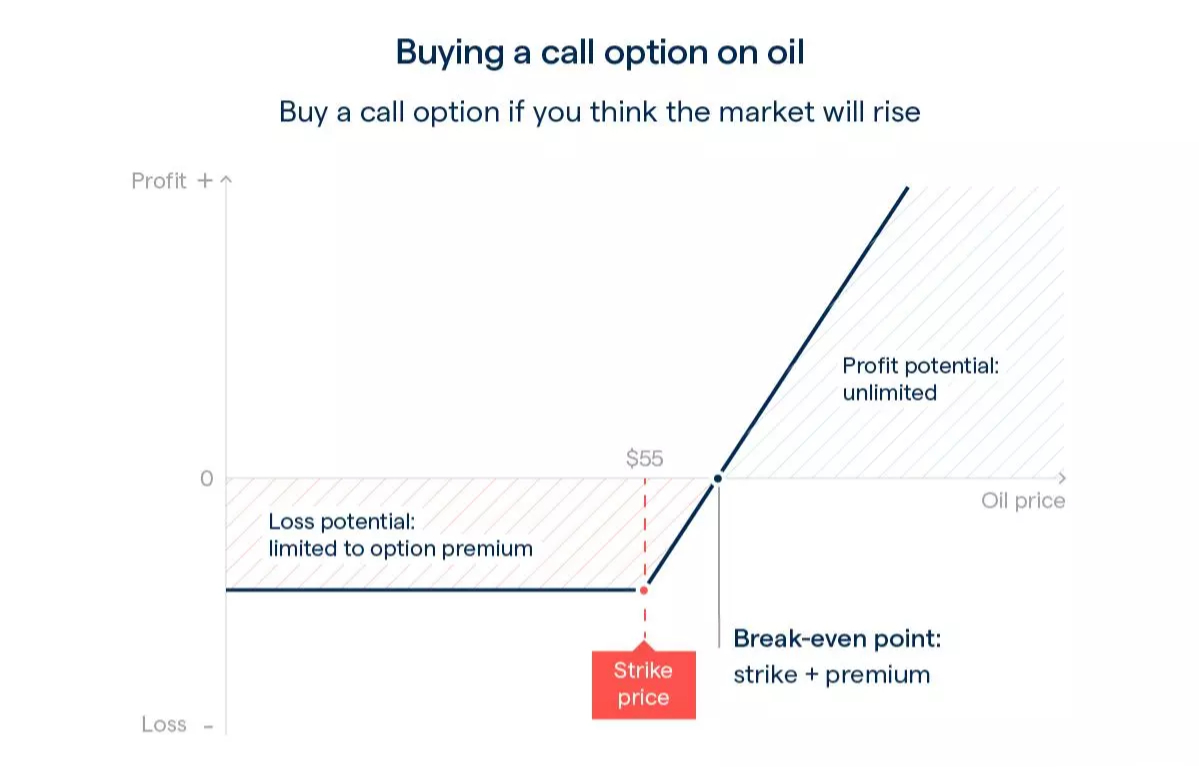
For example, let’s say that you expected the price of US crude oil to rise from $50 to $60 a barrel over the next few weeks. You decide to buy a call option that gives you the right to buy the market at $55 a barrel at any time within the next month. The price you pay to buy the option is known as the ‘premium’.
If US crude oil rises above $55 (the ‘strike’ price) before your option expires, you’ll be able to buy the market at a discount. But if it stays below $55, you don’t need to exercise your right and can simply let the option expire. In this scenario, all you’ll have lost is the premium you paid to open your position.
What is leverage in options trading?
Options are leveraged products; they enable you to speculate on the movement of a market without ever owning the underlying asset. This means your profits can be magnified – as can your losses, if you’re selling options.
For traders looking for increased leverage, options trading is an attractive choice. By choosing your strike and trade size you get greater control over your leverage than when trading spot markets.
If you're a UK trader who's buying call or put options with us, your risk is always limited to the premium (listed options)* if it expires out of the money, or margin (spread betting or CFDs) if you paid to open the position. However, it’s important to remember that when selling call or put options your risk is potentially high, so an effective risk management strategy is important.
* Your losses can be greater if they convert to long/short shares for expiring ITM and it experiences auto-exercises.
Understand options trading terminology
Traders use some specific terminology when talking about options. Here’s a rundown of some of the key terms:
- Holders and writers: the buyer of an option is known as the holder, while the seller is known as the writer. For a call, the holder has the right to buy the underlying asset from the writer. For a put, the holder has the right to sell the underlying asset to the writer.
- Premium: the fee paid by the holder to the writer for the option. When spread betting or trading options with us, you’ll pay a margin that works in a similar way to the premium
- Depending on the type of account, US options and futures accounts enable you to buy and sell call and put options
- Expiration date/expiry: the date on which the options contract terminates
- In the money: when the underlying’s market price is above the strike (for a call) or below the strike (for a put), the option is said to be ‘in the money’ – meaning that if the holder exercised the option, they’d be able to trade at a better price than the current market price
- Out of the money: If an option is out of the money at expiry, exercising the option will incur a loss
- At the money: when the underlying market’s price is equal to the strike, or very close to being equal to the strike, the option is referred to as ‘at the money’
- Break-even point: the point at which your trade or strategy is not making or losing money
