
Binary Option
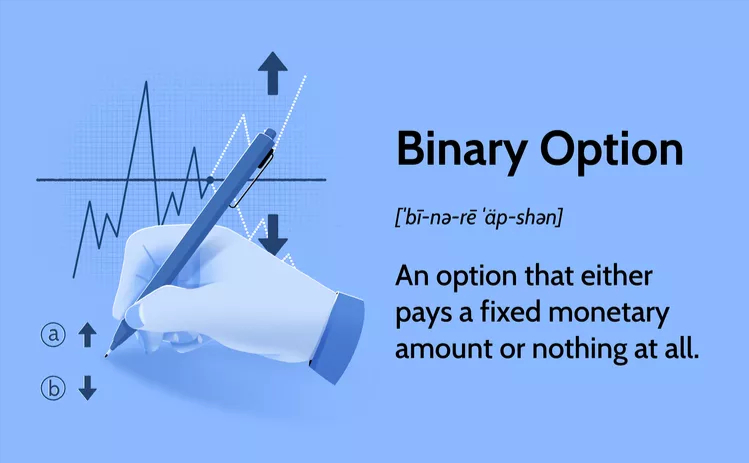
Binary options are financial derivatives where the outcome is a simple "yes or no" proposition.
What is Binary Option?
A binary option is a financial derivative that allows people to make all-or-nothing wagers on events and asset price changes. Although they have surged in popularity, U.S. regulators have cautioned against them and warn that these trades carry a high risk of fraud and losses for unwary investors.
These options depend on the outcome of a "yes or no" proposition, hence the name "binary." Traders receive a payout if the binary option expires in the money and lose if it expires out of the money. In 2008, the U.S. Securities and Exchange Commission (SEC) approved listing binary options as tradable contracts on exchanges. This move was followed by the Chicago Board Options Exchange and the North American Derivatives Exchange (Nadex), offering standardized binary options to retail traders.
Despite being available on regulated exchanges, much of the trading in binary options in the U.S. goes through unregulated offshore platforms, leading to many scams and frauds.
Binary options are banned in many places worldwide, including Australia, Canada, Europe, the U.K., and elsewhere.
Key Takeaways
- Binary options depend on the outcome of a "yes or no" proposition.
- Traders receive a payout if the binary option expires in the money and lose their wager if it expires out of the money.
- Binary options set a fixed payout and loss amount.
- Binary options don't allow traders to take a position in the underlying security.
- Most binary options trading occurs on platforms outside the United States.
How a Binary Option Works
Binary options have an expiry date and time. When that occurs, the price of the underlying asset or event must be on the correct side of the strike price (based on the trade taken) for the trader to make a profit.
A binary option automatically exercises, meaning the gain or loss of the trade is credited or debited to the trader's account when the option expires. That means the buyer of a binary option will either receive a payout or lose their entire investment in the trade—there is nothing in between.
An example of a binary option could be as simple as whether ABC's share price will be above $25 on April 22, at 10:45 a.m.
Let's say the client thinks the price will be trading above $25 on that date and time and is willing to stake $100 on the trade. If ABC shares trade above $25 at that date and time, the trader receives a payout per the terms agreed. For example, if the payout is 70%, the binary broker credits the trader's account with $70 in addition to their initial stake. If the price trades below $25 at that date and time, the client is wrong and loses their $100 investment in the trade.
As a result, many find binary options easier to understand than regular options—hence their popularity. Because of their risks, there are limits on how much you can trade. For example, the Nadex options exchange has a position limit of 2,500 contracts for most binary options.
